
Kalyug: Myth, Metaphor or Reality? A Dialogue Beyond Time

Is Kalyug merely an age described in ancient scriptures, or is it a metaphor for the moral and psychological challenges of our times? This profound question formed the basis of the latest Dharma Charcha – Youth Edition, where scholars, thinkers, an entrepreneur, and young voices came together to explore one of Indian philosophy's often discussed concepts. See the full video here.
The discussion began by examining the traditional understanding of Kalyug. Drawing from the Vishnu Purana and Bhagavata Purana, Dr. Devendra Nath Ojha, Head of Sanskrit Department & Assistant Professor, Amity Institute for Sanskrit Studies, explained that Kalyug is indeed recognised as the fourth and final age in the Vaidik cycle of time, characterised by a gradual decline in righteousness, compassion and human longevity. Yet, he reminded us that even in this age, virtue continues to exist, making personal transformation not only possible but necessary.

Veteran litterateur Lakshmi Shankar Vajpeyi Ji shifted the discussion from scripture to society. Referring to Tulsidas' Ramcharitmanas, he highlighted how many of the signs traditionally associated with Kalyug—falsehood, hypocrisy, declining family values and the glorification of appearances over substance—remain strikingly relevant today. At the same time, he cautioned against using Kalyug as an excuse for inaction. Every individual, he argued, still possesses the ability—and responsibility—to improve society.
Offering a modern perspective, entrepreneur and engineer Mr. Raveen Jain proposed that Kalyug is not merely something we live in, but something we either allow or refuse to enter our own lives. Technology, he observed, amplifies both good and bad. While negative news spreads rapidly and often dominates public attention, every individual still retains the freedom to choose the values they cultivate. His central message was simple yet powerful: change begins with personal responsibility.
Presenting the Jain philosophical perspective, Dr. Medhavi Jain, Founder, Dharma For Life, explained that Jain scriptures do not use the term Kalyug, but instead describe the present era as the Pancham Kāl (Duṣamā Kāla)—an age marked by increasing sorrow and moral decline. Through the sixteen dreams of Emperor Chandragupta Maurya, interpreted by Acharya Bhadrabahu, she illustrated symbolic warnings that remain remarkably relevant even today: the decline of genuine knowledge, ethical leadership, social harmony, environmental balance and moral character. These dreams, she explained, are not merely predictions but timeless reflections on the consequences of losing sight of truth, restraint and wisdom. She also recited a poem she wrote on Kalyug. You can watch it here.

The youth panel, Divyanshi and Muskan, added an equally important dimension to the conversation. While
acknowledging rising mental health challenges, materialism and the erosion of community life, they also challenged simplistic narratives. Technology, they observed, has brought both unprecedented convenience and new forms of isolation. Rather than blaming Kalyug itself, they encouraged accountability, independent thinking, deeper engagement with nature and the cultivation of critical reasoning.
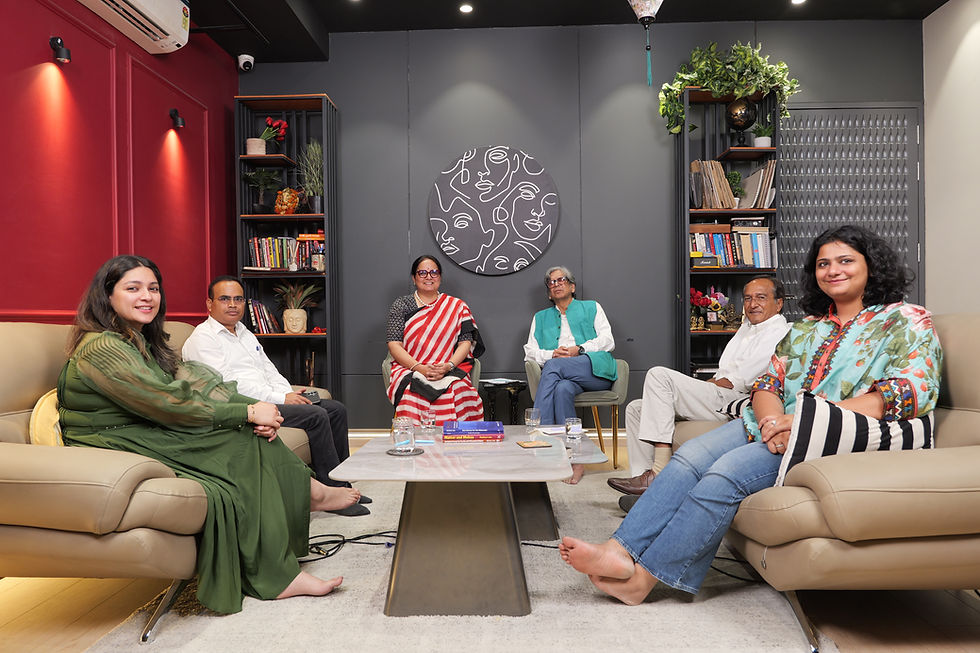
Perhaps the most meaningful consensus emerged towards the end of the discussion. Whether Kalyug is viewed as a historical age, a symbolic metaphor or a lived social reality, all the panellists agreed that its influence is not inevitable. Human beings continue to possess the freedom to choose compassion over greed, discernment over blind belief and responsibility over resignation.
The discussion concluded with a powerful reminder: the real question is not whether Kalyug exists, but whether we allow its qualities to govern our own thoughts, actions and relationships. If every individual strives to uphold truth, character and self-awareness, then even in the midst of Kalyug, the spirit of Satyug can still be experienced.
In the end, Dharma is not merely something we inherit from the past—it is something we choose to live in the present.
To catch glimpses of the podcast, click here.
By Dharma For Life


Comments